 EN
EN  PT
PT  ES
ES 30 essential terms to understand the language of sanitation.
Have you ever been in an operational planning meeting or opened a technical report and felt like the team was speaking another language? The sanitation sector is full of terms, acronyms, and hydraulic jargon that confuse even those with years of experience.
Today, with the goals of Legal Framework for Sanitation (Law No. 14.026/2020) efficiency, loss reduction and digitization of networks It's not a differentiator, it's a requirement. Confusing a field concept or an office metric can hinder project approval or lead to misunderstandings with regulations.
To definitively eliminate doubts and streamline your team's routine, we've compiled the most commonly used industry terms in this guide, explained in a simple, direct, and straightforward way. Save this link for quick reference!
General Hydraulics: The Behavior of Water in the Network
Understanding the physics behind fluid movement is the foundation for preventing structural failures in pipelines.
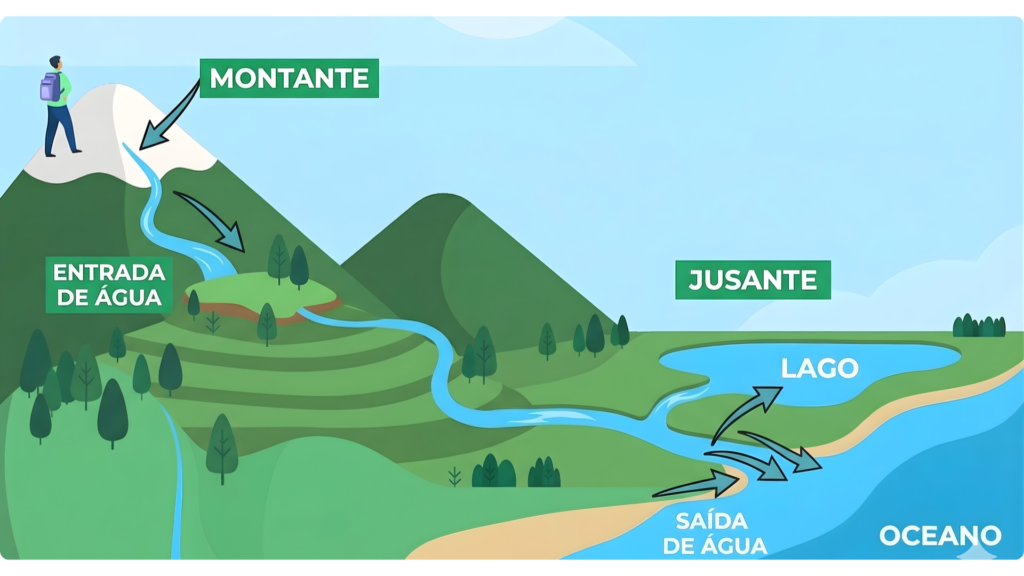
Upstream vs. Downstream: The industry's number one geographical confusion.
Amount It's the part where the river begins, at the highest point of the topography. In a booster pump, it's the side where the water enters.
Downstream This is where the river ends and begins to supply another river, a lake, or even the ocean. In a booster pump, it's the side where the water exits.
Water hammer: It is a phenomenon that occurs in pipelines when there is an abrupt change in the flow velocity of a liquid. This change generates pressure waves that act like punches on other equipment in the pipeline.
Cavitation: Resulting from the implosion of water vapor bubbles, generated by low pressure or high flow velocity, which causes erosion in pipes, valves, and pumps.
Raw Water Pipeline (AB) vs. Treated Water Pipeline (AT): A AB It transports water in its natural state from the intake point to the treatment plant (WTP). AT It carries purified, potable water from the water treatment plant to the city's distribution reservoirs.
Suction cup: It is a type of automatic valve installed at high points in the network (such as water mains or distribution networks). Its main function is to eliminate air accumulated inside the pipe during filling, as well as to admit air during emptying.
Repression: The hydraulic act of pumping or propelling water from a lower topographic point to a higher one.
Loss Management and Water Balance
Controlling waste requires rigorously mapping the destination of every drop of water through the Water Balance.
Actual (Physical) Losses vs. Apparent (Commercial) Losses: To the Actual Losses These refer to water that physically escapes the system through holes, cracks, or reservoir overflows. Apparent Losses These occur when water is consumed but does not generate revenue due to fraud ("illegal connections"), under-measurement by water meters, or reading errors.
Non-Revenue Water (ANF): It is the volume of water that is produced and introduced into the distribution system, but which does not generate revenue for the sanitation company.
DMC (District Measurement and Control): It is a geographically defined area within a water distribution network. It has water meters at the inlet and outlet, and is isolated by valve controls. Illustratively, it is like a neighborhood within a municipality.
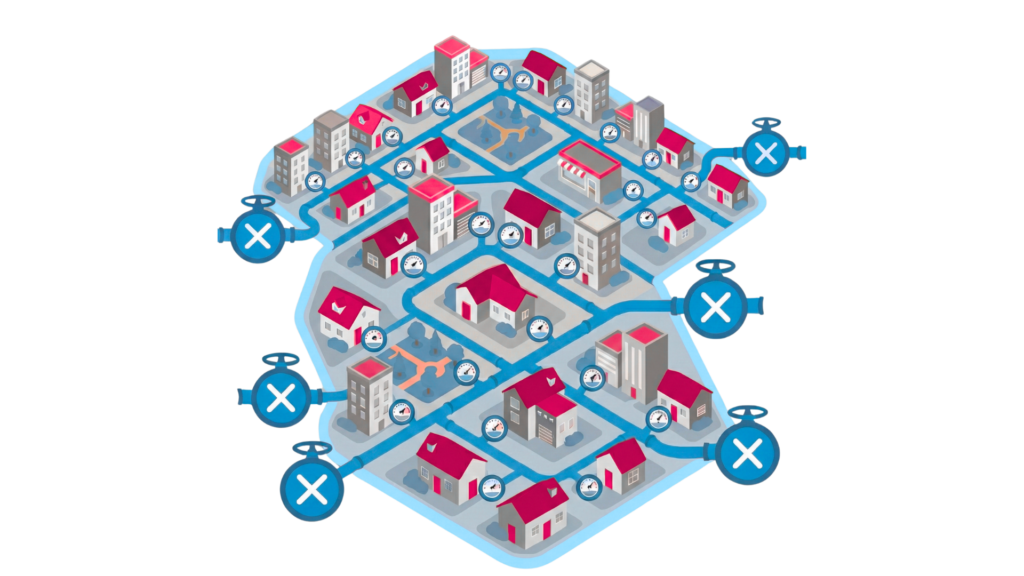
Macro-measurement vs. Micro-measurement: A Macrometric measurement It is the measurement of large volumes of water at strategic points in a supply system. For example, it is carried out at the outlet of treatment plants, and at the inlet and outlet of reservoirs or pressure vessels. It serves an operational control function. Micromeasurement It is the measurement of individual water consumption in each user unit (residence, business, industry) through water meters. It has a commercial function, billing related to the measured consumption.
Minimum Night Flow (VMN): It is the volume of water per unit of time (L/h or m³/h) that flows through a distribution network in a DMC during the hours of lowest legitimate consumption, typically in the middle of the night.
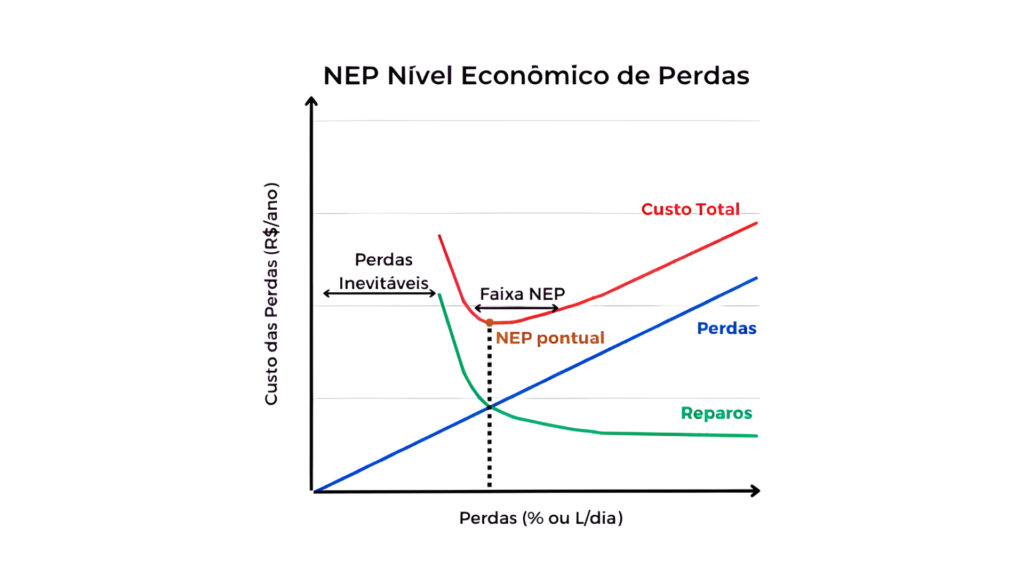
NEP (Economic Loss Level): The volume of water losses, while not zero, represents the point at which the cost of further reducing losses becomes greater than the financial (and environmental) benefit of recovering that water.
Technical Acronyms and Regulatory Metrics
Regulatory reports and modeling software utilize a series of standards based on global best engineering practices.
IVI (Infrastructure Leakage Index) or ILI (Infrastructure Leakage Index): It is one of the water loss performance metrics used for actual losses. It is the ratio between Actual Losses and Unavoidable Losses.
IVI = PR / PRAI in Portuguese
ILI TIRL / UARL in English.
PR (Index of Unavoidable Annual Real Losses) or TIRL (Unavoidable Annual Real Losses): The difference between the water that enters the network and the water that is consumed and billed, excluding apparent losses.
PRAI (Index of Unavoidable Annual Real Losses) or UARL (Unavoidable Annual Real Losses): The calculated value of the minimum actual losses that a well-maintained and managed network could achieve.
PRV (Pressure Reducing Valve): It is a type of control valve designed to automatically reduce high pressure at the network inlet to a safe and constant level at the outlet, in a sector or DMC.
Top-Down vs. Bottom-Up: Two ways to calculate losses. The methodology Top-Down It estimates losses on a macro level, through mathematical exclusion of balance sheet data. Bottom-Up It calculates the actual loss from the bottom up, adding measurements, tests, and direct field data.mca (Meters of Water Column): A unit of pressure measurement that expresses the pressure exerted by a column of water 1 (one) meter high.
Technological Innovation and a Sustainable Future
The most efficient operators in the market are leaving reactive management behind and transforming raw data into intelligent decisions.
IoT (Internet of Things): Internet of Things
Machine Learning: Machine Learning. It is an area of Artificial Intelligence (AI) that allows a computer to learn from data, identify patterns, and make decisions or predictions, without having been specifically programmed for each scenario.
Greenwashing vs. Greenhushing: Highly relevant corporate ESG terms. Greenwashing It's the greenwashing of data to make it seem sustainable. Greenhushing This occurs when the distributor omits or hides its environmental goals for fear of criticism or market audits.
Demystify Industry Terms and Concepts
Mastering these terms is fundamental to transforming the operational efficiency of your distribution company. However, you don't need to memorize all the formulas, SINISA indicators, short-term classifications, and units of measurement on your own.
We prepared the Sanitation Glossary Complete from A to Z. A rich, practical, and completely free resource, designed for engineers, operators, managers, and consultants to use as their ultimate daily reference guide on their mobile phone or computer.